‘‘AnLatomy: The Latin Dance Anatomy’’
The Latin Dance Anatomy
This is a landmark, era‑defining work that integrates anatomy, biomechanics, and dance technique—combining scientific rigor with artistic vitality to open a new horizon for Latin dancers. Created jointly by seasoned dancers, performance coaches, medical experts, and physical therapists, the book applies meticulous analysis and cross‑disciplinary insight to deeply deconstruct the movement logic behind Latin dance, unveiling the dynamics of kinetic chains, core stability, and energy transmission, and redefining the future of dance education and performance.
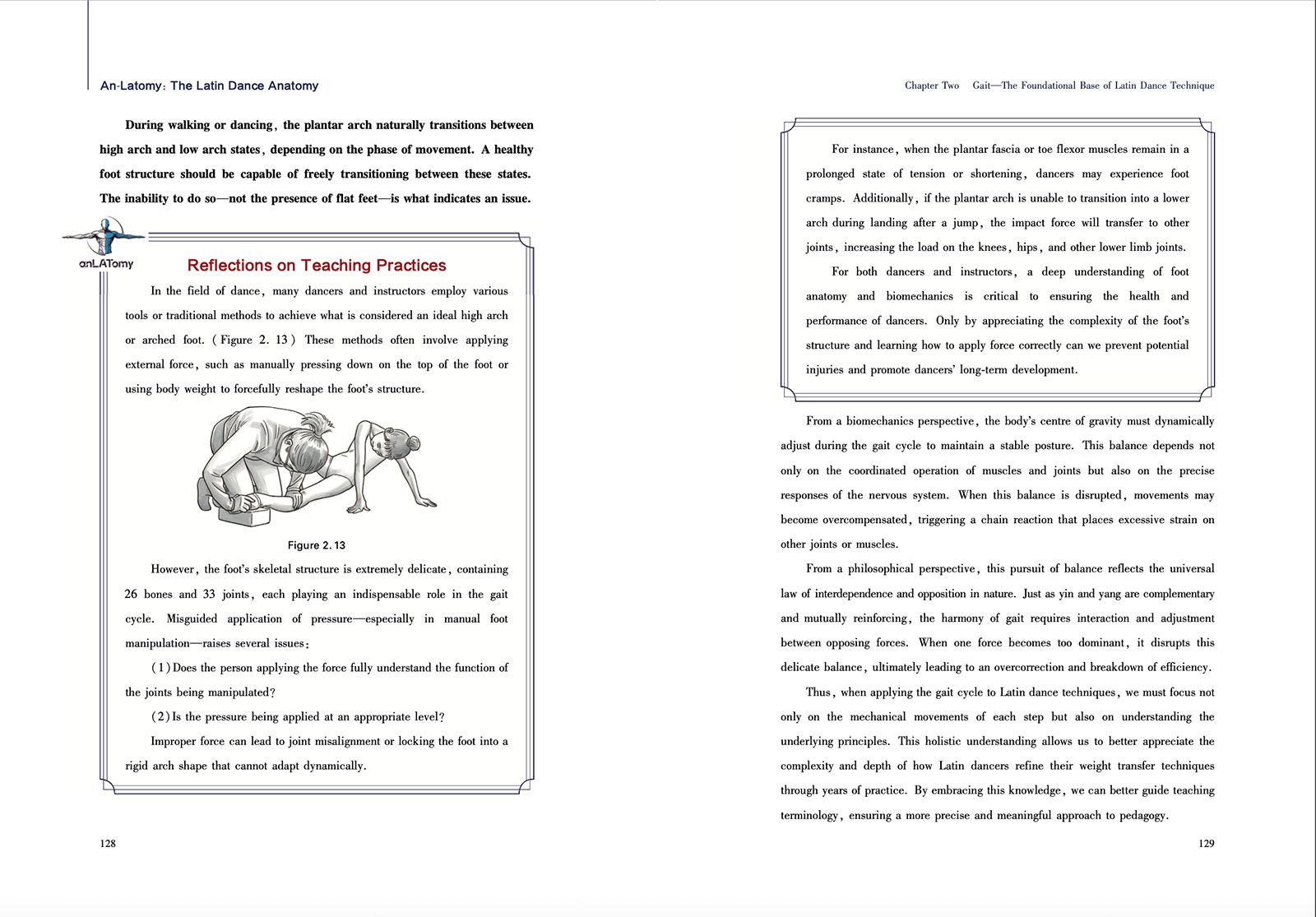
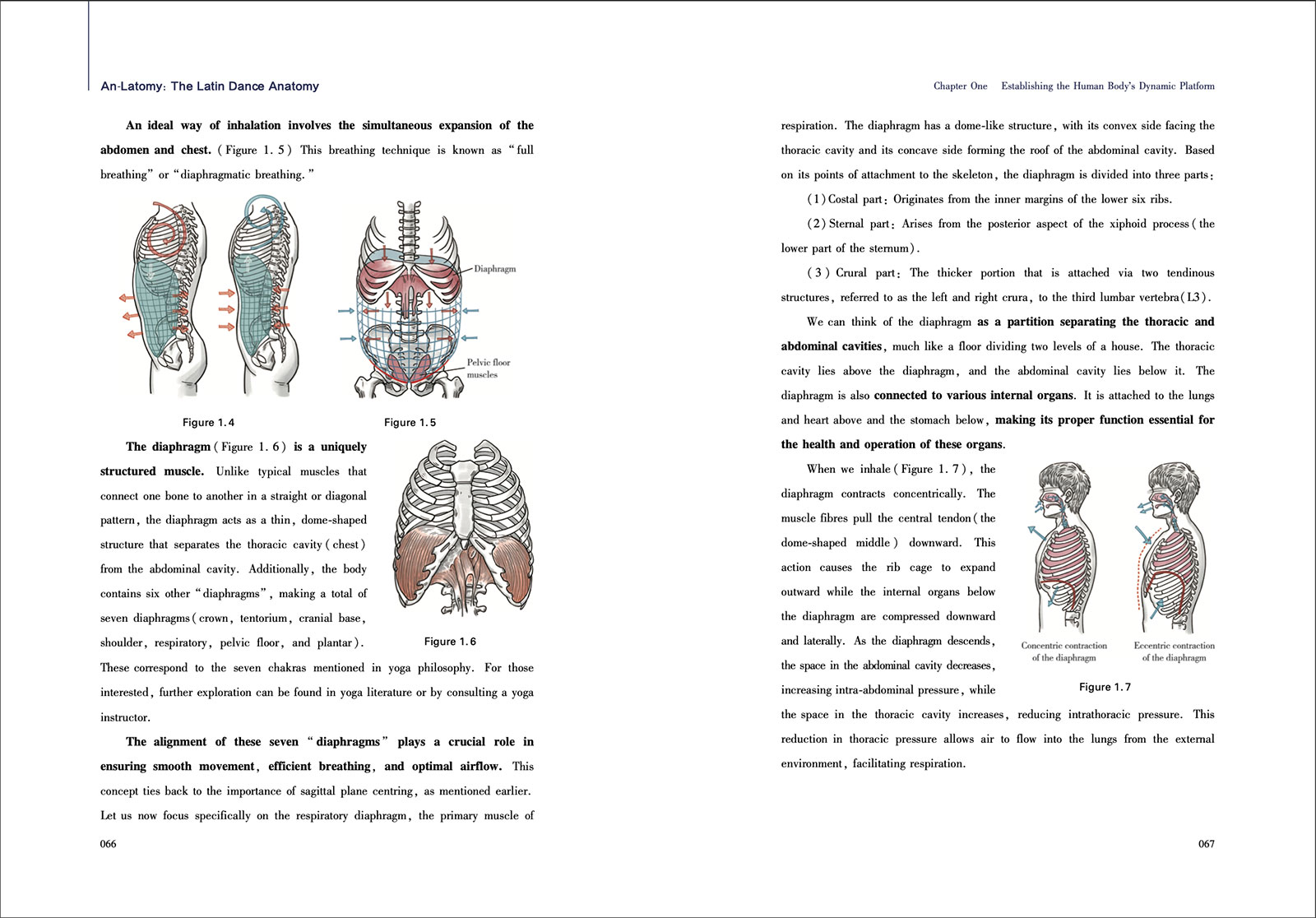
From breathing—the unseen driving force—to the refined details of gait and rotation; from safeguarding joint health to releasing the body’s full potential, this book builds a science‑based bridge toward technical elevation and performance breakthroughs. With nearly 300 finely crafted illustrations, it brings to life the internal connections between human structure and dance movement, rendering complex concepts instantly graspable and interweaving theory with practice into singular inspiration.

Why It’s Worth Getting Now
– Build the right foundational logic and avoid detours: Using breath, core, and gait as a dynamic platform, this book brings Latin dance from surface-level styling back to verifiable sports science and anatomical frameworks—so you don’t spend years practicing with limited progress.
– Correct common pitfalls with precision: For typical mismatches like “forward‑biased center of mass,” “over‑bracing the core/abs,” and “shoulder‑driven rotation,” you’ll get clear replacement strategies and actionable steps to immediately improve stability and rhythmic quality.
– Train safer, for longer: Centered on five kinetic chains and coordination across the three planes of motion, it optimizes force transmission and joint tasking—reducing risks like knee hyperextension, plantar fascia stress, and low‑back compensation—to support sustainable training.
– Turn “I understand” into “I can do it”: Each chapter closes with a recap, Q&A, FAQs, and corrections, grounding abstract concepts into checklists and practice pathways that shorten the distance from comprehension to performance.
– For teaching and self‑learning alike: From core problem guides to a glossary of terms and joint‑specific applications, it builds a shared language for coaches and dancers, improving communication efficiency and instructional consistency.
– A foundation for multiple styles and cross‑disciplinary use: Principles of gait, the spinal engine, and the oblique kinetic chains extend across Latin styles and cross‑validate with functional training—one investment, many returns.
Book Modules and Takeaways
Module I | Core Concepts and Foundational Theory: Build a common language so movement can be “read”
– Integrate the three planes of motion via first principles:
Sagittal plane carries stability; frontal plane manages the center of mass; transverse plane releases rotation.
– Use kinematics and muscle contraction mechanisms to clarify the “how” and the “why,” side by side.
– Takeaway: You’ll move beyond vague cues to identify “where the work happens and who is doing it,” upgrading from intuition‑based practice to measurable progress.
Module II | The Five Kinetic Chain Systems: Give force the right pathway
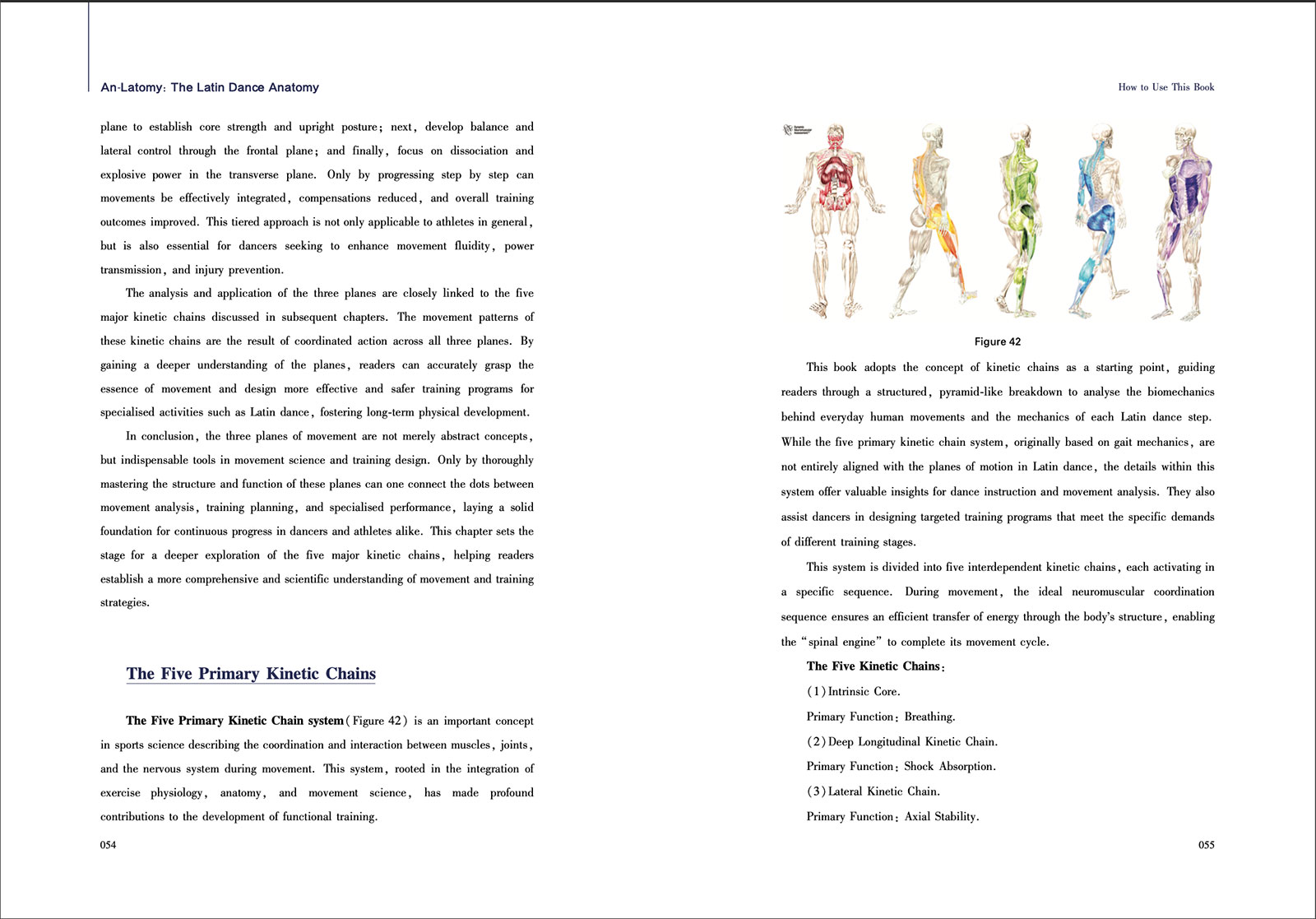
– Initiate from the intrinsic core, connect through deep longitudinal and lateral chains, then link the posterior oblique and anterior oblique chains—forming a complete sequence from stability to output.
– Thread “breathing—center of mass—energy storage—release” into a perceptible river of propulsion.
– Takeaway: Steps feel springier, rotations more efficient, rhythms more three‑dimensional; movement relies less on local effort and more on whole‑body transmission.
Module III | Key Joints and Dance Applications: Find the threshold between stability and freedom
– Foot and gait: Use four‑phase rolling and the windlass mechanism to secure propulsion efficiency and soft landings.
– Spinal engine: Drive top‑down sequencing via the thoracic spine; use coupled motions to unlock rotational range.
– Functional roles of the hip, shoulder, knee, and ankle: In closed‑chain contexts, let the hip lead; coordinate scapula‑thorax; keep the knee as the stabilizing timekeeper; use eccentric control at the ankle to modulate tension.
– Confront teaching myths head‑on: Case‑based language analyzes “frame and lead,” “arm lines and proximal–distal coordination,” grounding “looking good” in “working well” biomechanics.
– An easy‑to‑read knowledge map: Core‑problem guides weave the book’s main thread; a master list of key terms and concepts speeds cross‑reference and review.
– Actionable in every chapter: Chapter‑end recaps, Q&A, and practice prompts provide instant checks and training strategies, helping you apply insights immediately in class and in solo practice.
Highlights & Value Proposition:
Turn experience into method. Turn method into results.
-Cross‑disciplinary co‑creation, grounded in evidence
Co‑authored by seasoned dancers, performance coaches, medical experts, and physical therapists. Clinical observation, movement assessment, and on‑floor data cross‑validate the teaching pathways—every line of instruction is rooted in biomechanics.
-Nearly 300 illustrations—beautiful and exacting visual grammar
Each illustration pairs a body sensation with a practice protocol, translating abstract concepts into actionable movement. You’ll understand it, you’ll do it, and you’ll teach it clearly.
– Authoritative endorsements—built on practice, not promotion
Joint endorsements from past world champions and top coaches. Content is anchored in solid biomechanics and expressed in precise, actionable language that ties the body to technique—turning abstract “feel” into reproducible training flows. It not only increases performance density for dancers but also reduces injury risk, offering durable pathways and methods for teaching and high‑intensity training. A core resource you can trust—and rely on long term.
Audience Fit: Different backgrounds, one shared trajectory of progress
– Professional dancers and coaches: A unified language that sharpens teaching precision—details gain foundations, performance gains consistency.
– Medical and performance professionals: Mechanism‑driven interventions that raise quality and efficiency—shortening the distance from theory to practice.
– Passionate learners of dance: Plain‑language explanations and illustrated drills build body awareness, lower barriers, and heighten kinesthetic feel.
Order Now
Latin Dance Anatomy (Traditional Chinese)
A book titled “Latin Dance Anatomy” in Traditional Chinese
USD83.20
Latin Dance Anatomy (Simplified Chinese)
A book titled “Latin Dance Anatomy” in Simplified Chinese
USD83.20
Latin Dance Anatomy (English)
A book titled “Latin Dance Anatomy” in English
USD83.20
Latin Dance Anatomy Bundle (Traditional Chinese + English)
Latin Dance Anatomy Bundle(Traditional Chinese + English) two books, 20% off
USD166.41 Original price was: USD166.41.USD133.02Current price is: USD133.02.